PROMPT This AI Challenge
"Creativity vs. Productivity: Why Marketers Still Matter in the AI Era" featuring Deepak Deolalikar
Every episode of the PROMPT This podcast ends with an AI Challenge—a hands-on experiment to turn AI theory into practical skill.
AI search has quietly become the new front door of the internet. Whether your customers use ChatGPT, Perplexity, or the AI embedded in their CRM, they are already relying on machine reasoning to surface products, partners and vendors. If your brand is not visible in these systems, you are invisible where decisions increasingly begin.
To help teams benchmark where they stand, we have two practical options you can run today.
AI Brand Visibility Challenge: Two Paths to See How Your Brand Shows Up
Option 1: If You Have a Business Email Account
You can utilize the Ziply AI Visibility Report. Here's how:
Step 1: Get Your Company’s AI Visibility Report
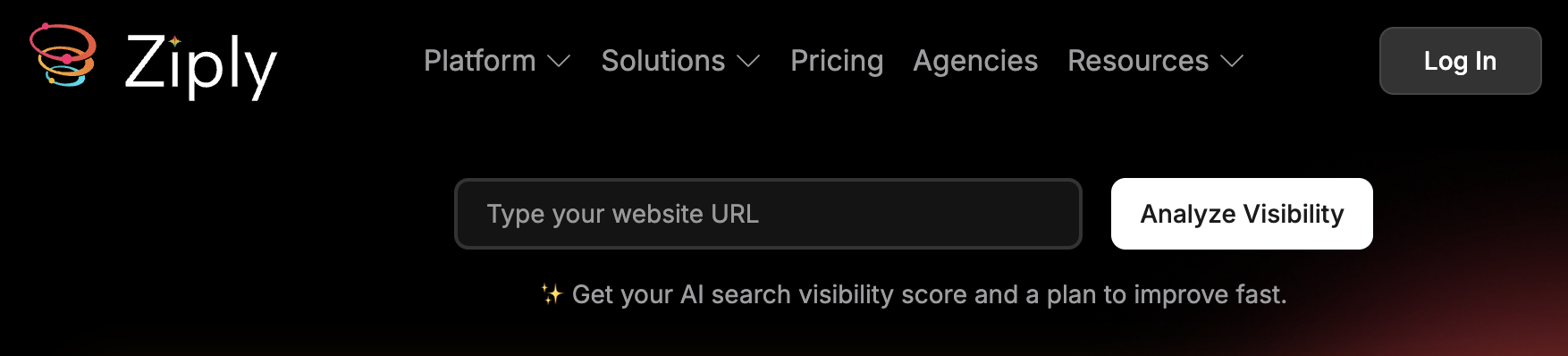
- Go to Ziply.ai, enter your company URL
- Enter you work email
- As your OTP code is being sent, you will be able to click on the 'View Visibility Report' button on the right. Your report will appear. You will also be given the opportunity to sign up for the 5-day trial at this time.
The free trial surfaces a dashboard that evaluates your brand across categories including:
-
Brand Mentions
-
AI Visibility
-
Citation Authority
-
Brand Coverage
-
Share of Voice
-
Visibility Score
-
Sentiment
This is the foundation of your AI visibility score.
Step 2: Interpret Your Core Metrics
Use the AI Visibility report as a guide for both your marketing and product organizations. The tool provides a structured interpretation of how well AI systems can describe, reference and trust your business.
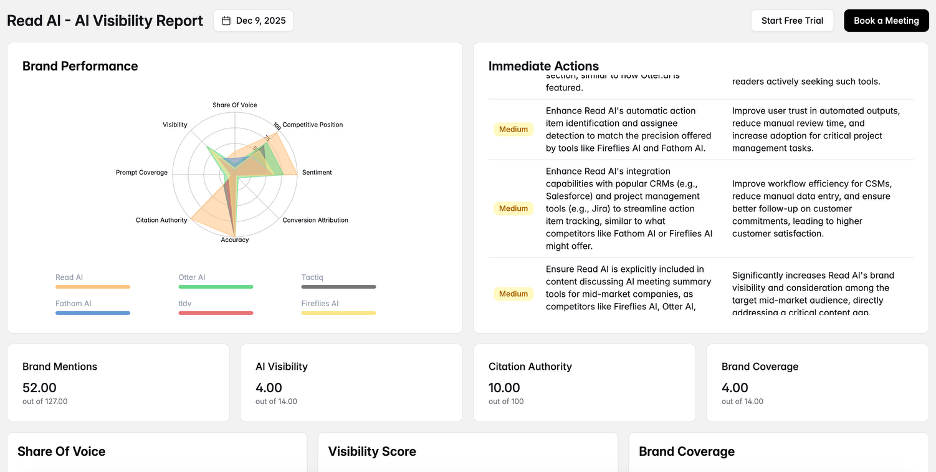
Key metrics to review:
- Share of Voice - Perhaps the most strategic metric, it measures the percentage of all AI-generated brand mentions in your competitive set that reference your company.
- Brand Mentions - How often AI systems reference your company compared to known competitors.
- AI Visibility - A quantitative signal of how frequently your brand appears in AI search outputs.
- Citation Authority - AI models grade how authoritative your brand appears relative to available sources like Wikipedia or Reddit.
- Brand Coverage - How well your offerings are covered across AI systems.
- Visibility Score - This measures how visible you are relative to competitors.
Step 3: Assess Immediate Actions and Strategic Priorities
The Ziply report includes a section titled “Immediate Actions,” which provides concrete recommendations prioritized by impact.
Your challenge is to:
-
Identify which recommended actions improve visibility fastest
-
Determine whether your content is too vague, inconsistent or incomplete
-
Evaluate gaps in how AI interprets your offerings, positioning, or differentiation
-
Map the competitive weaknesses highlighted in the radar charts
This forces leadership teams to address visibility not as a marketing project but as a strategic risk.
Step 4: Compare Your Report Against Competitors
Use the same tool to analyze your key competitors.
The comparative radar chart shows how AI positions brands relative to each other across categories like:
-
Competitive Position
-
Visibility
-
Prompt Coverage
-
Sentiment
-
Accuracy
-
Citation Authority
(Each axis of the radar chart gives strategic signals about strengths and weaknesses.)
Once you run competitor URLs, look for:
-
Gaps larger than 20 percent
-
Weak authority scores
-
High hallucination risk
-
Missing product categories in AI summaries
-
A lack of distinguishable differentiation
Step 5: Brief Your Executive Team
Turn findings into a leadership conversation:
-
Are we visible enough in AI search to be shortlisted by buyers?
-
Do AI systems understand our offerings at a level that accurately represents us?
-
Is our content structured for machine comprehension, not just human eyes?
-
Where are competitors outperforming us and why?
-
What is the cost of inaction as AI becomes the new source of truth?
This is where the challenge becomes a strategic imperative.
Option 2: If You Don't Have a Business Email Account
Try this DIY AI Visibility Challenge instead. A quick, way to see how AI tools describe your brand. Think of it as a scavenger hunt: you’ll ask everyday questions in free AI platforms and discover whether your company shows up, how it’s portrayed, and how you stack up against competitors.
Step 1: Open a free AI tool (ChatGPT, Gemini, Perplexity).
Step 2: Ask simple questions like:
- What does [your company name] do?
- Who are the top companies in [your industry]?
- What are the best options for [your product or service]?
Step 3: Notice what shows up
- Is your company mentioned?
- Is the description accurate?
- Who gets mentioned instead?
Step 4: Run the same questions for competitors
Step 5: Spot the gaps:
- Missing mentions?
- Vague or incomplete descriptions?
- Competitors described more clearly?
Step 6: Share findings with your team as a quick visibility snapshot
By the time you finish this DIY challenge, you’ll have insights of how AI tools see your brand today and where competitors may be getting more attention. It’s not a full report, but it’s enough to spark important conversations inside your team and highlight areas worth improving. Think of it as a first step: a quick, no‑cost way to test your visibility in the AI era.
Final Thoughts
AI search is reshaping how customers discover vendors. The companies that win are those that communicate clearly enough for intelligent systems to understand, categorize and recommend. Whether you use the Ziply AI Visibility Report or the DIY option, the goal is the same: to understand how visible your brand is in the AI-first era. If AI tools can't explain your company clearly, customers may not find you either.
