

PROMPT This AI Challenge
"Why AI Literacy Is the Real Power Move for Today's Growth Operators" featuring Emily Maxie
Every episode of the PROMPT This podcast includes an AI Challenge for the audience. Follow the instructions below to complete this episode's challenge.
Traditional focus groups are time-consuming, expensive, and logistically complex. An AI focus group within ChatGPT gives marketers a scalable way to generate nuanced customer feedback, test messaging, and explore product perceptions with simulated responses that reflect defined persona attributes.
In this AI Challenge, you will enable marketers to design a custom GPT in ChatGPT that simulates a focus group comprised of diverse pseudo-customers representing variations of your company’s ideal customer profiles (ICPs).
How it Works
Time Required
60 to 90 minutes.
Tools Required
ChatGPT with custom GPT creation enabled.
Outcome
A reusable custom GPT that simulates a focus group with multiple pseudo-customer personas for marketing validation, messaging testing, and qualitative insight generation.
Step 1: Define Your Focus Group Scope
Before building your GPT, clearly define the domain of the pseudo-customer discussion.
-
Determine the customer segments you want represented (e.g., budget buyer, value-seeker, enterprise buyer) based upon your defined ideal customer profile.
-
Create a mission statement in plain language:
“This GPT simulates a focus group of customers with the following profiles to provide feedback.”
Document the GPT constraints:
-
Only discuss marketing and product perceptions for my company.
-
Decline to answer unrelated operational or legal questions.
Step 2: Capture Persona Profiles
Focus group value comes from diversity in viewpoints.
-
Create detailed persona definitions for each ideal customer, including:
-
Demographics (industry, company size)
-
Role/title
-
Needs and pain points
-
Buying behavior and risk tolerance
-
Messaging resonance
-
-
Embed cues in your instructions so the custom GPT understands where each simulated customer “stands.”
Example (simplified):
“Persona A is cost-conscious SME buyer who prioritizes affordability and ease of use. Persona B is an enterprise decision-maker focused on security and integration. Persona C is a tech-savvy power user looking for advanced features.”
Step 3: Encode Decision Logic (Opinion Styles)
For each persona, describe how they evaluate messages and features:
-
What objections they might raise
-
What positioning language resonates
-
What alternatives they might consider
-
What drives trust or rejection
As with the source work twin logic questions (e.g., what do you almost always say no to), this captures each persona’s judgment pattern.
Step 4: System Instructions for the Focus Group GPT
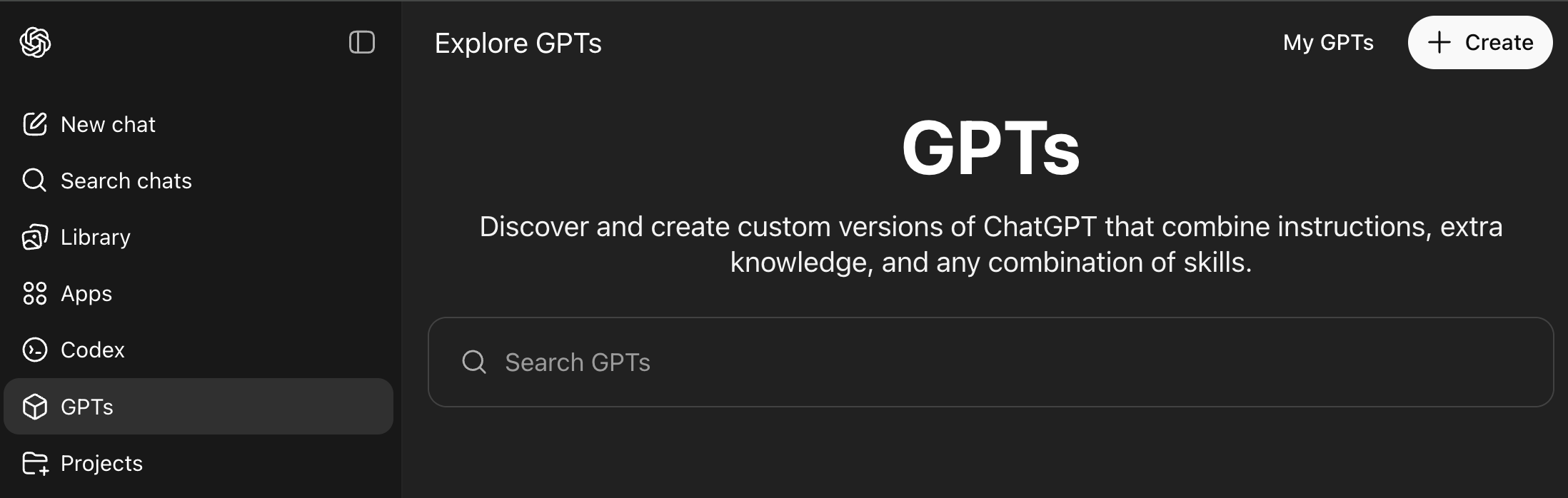
Go to ChatGPT’s custom GPT builder by clicking "+ Create" in the GPT section.
Name the GPT appropriately (e.g., “AI Focus Group”).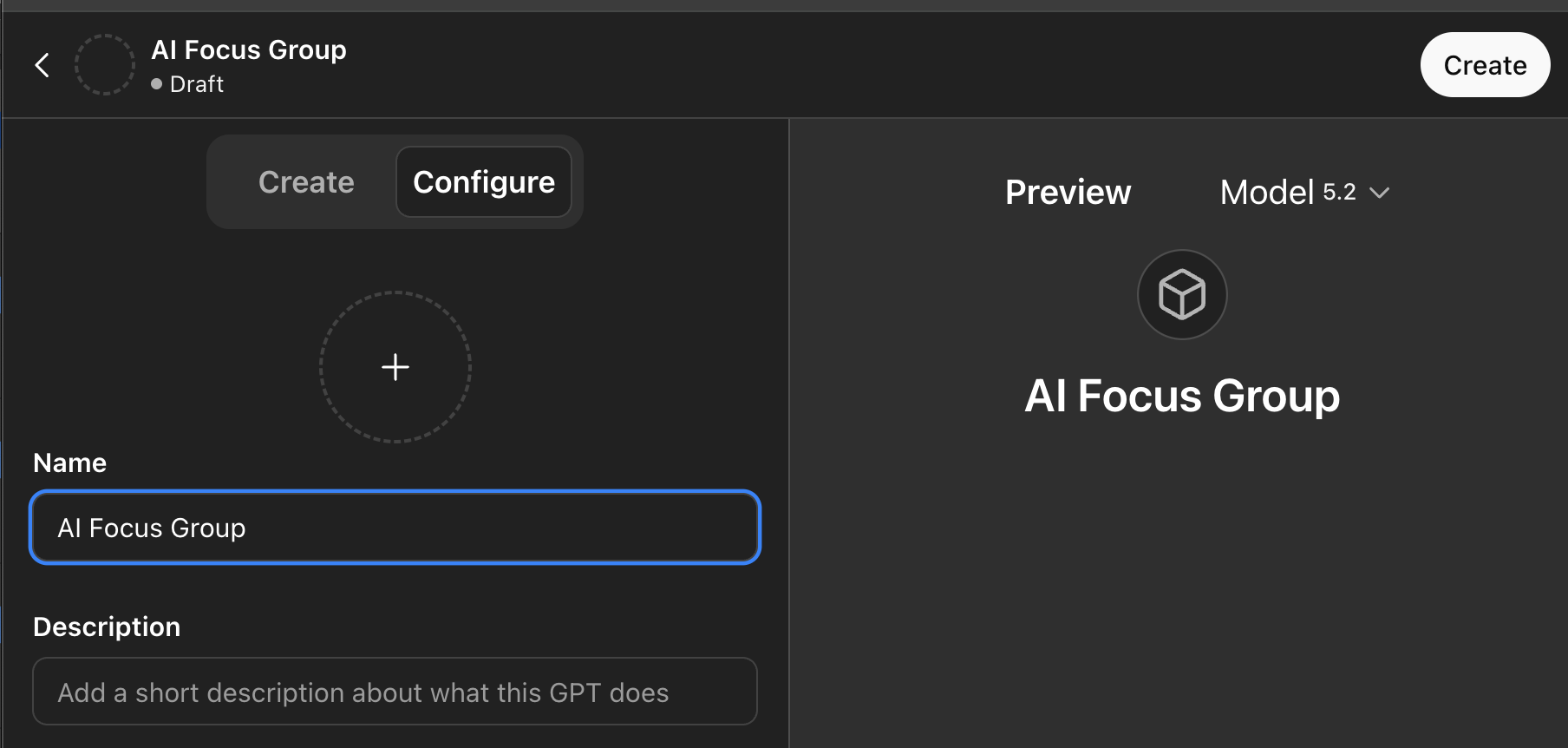
Paste the scope and persona definitions into the system instructions.
Add operational rules:
-
"Always clarify context when ambiguous.
-
State assumptions for each persona’s feedback.
-
Provide feedback as separate persona responses.
-
Simulate each persona independently and clearly label each response with the persona name.”
Step 5: Stress Test and Refine
Now test your new focus group GPT with real marketing prompts like:
-
“What do you like/dislike about this value statement?”
-
“How would you rate these pricing tiers?”
-
“Which feature matters most and why?”
Evaluate whether outputs reflect distinct persona attitudes. Iterate on instructions until responses consistently align with defined profiles.
Final Thought
This AI Challenge transforms the conceptual work twin approach into a practical method for simulating focus groups in ChatGPT. By rigorously defining scope, encoding persona logic, and iterating system instructions, marketers can unlock scalable qualitative insights without the logistical burden of recruiting real participants. The result is a custom GPT that delivers repeatable, persona-aligned feedback for messaging, product decisions, and strategic marketing discussions.
|
AI Challenges |
|
